Showing posts with label language arts. Show all posts

Tuesday, July 8, 2014

What I've Read This Summer!

I've been reading A LOT this summer and I'm loving it! I wish I had more time to do so during the school year. I've been reading for personal enjoyment, but also some chapter books I think my 5th graders may enjoy reading. I want to be able to give some great book commercials (if you haven't read Donalyn Miller's Reading in the Wild-what are you waiting for?!?! Pick it up now! She discusses this in her book). Here are my reviews from last weeks great books.


The Fault in our Stars, By John Green Synopsis
The Fault In Our Stars is a fabulous book about a young teenage girl who has been diagnosed with lung cancer and attends a cancer support group. Hazel is 16 and is reluctant to go to the support group, but she soon realises that it was a good idea. Hazel meets a young boy named Augustus Waters. He is charming and witty. Augustus has had osteosarcoma, a rare form of bone cancer, but has recently had the all clear. Hazel and Augustus embark on a roller coaster ride of emotions, including love, sadness and romance, while searching for the author of their favourite book. They travel to Amsterdam in search of Peter Van Houten the author of An Imperial Affliction. While on their trip Augustus breaks some heartbreaking news to Hazel and both of their worlds fall apart around them. If you enjoy young adult books, full of witty humour and heartbreaking events, this book is perfect for you. Expect to laugh, cry and smile throughout this novel. (The Gaurdian)
 
My Thoughts on the Book
I really enjoyed reading this book. It was witty and has an unflinching look at mortality. It was an easy read and at times difficult to put down. This is definitely a book for high school aged students (in my opinion). There are some topics that deal with sexuality and I wouldn't feel comfortable with a student in my class reading this or even in middle school/jr. high. I haven't seen the movie yet, but will once it comes out. I'm always curious to what is better the book or the movie and more often than not the book is way better.


Miss Peregrine's Home for Peculiar Children, By Ransom Riggs Synopsis
 Jacob has listened to his grandfather’s mysterious and fanciful tales about his childhood all his life, but he always assumed they were exaggerations.  That is, until one day, when sixteen-year-old Jacob finds his grandfather dying after some sort of vicious attack and sees the monster that murdered him, something right out of his grandfather’s stories.  Desperate to understand what has happened, Jacob travels to a small island off the coast of Wales in order to find the truth about his grandfather’s past. (S. Krishna's Books)
My Thoughts on the Book
This book started off with a bang! It was so suspenseful and I was hooked right from the beginning, but midway through the book my interest started to fizzle, just a bit. I do like the vintage photos that were used throughout the novel. They added to the mystique of the story line. It was definitely an interesting and unique book. The cover does give the book a creepy feel, but it isn't as scary as it may seem. There are some frightening elements, but it is more of a fantasy than anything else.
 

 The Seer of Shadows, By Avi Synopsis
Newbery Medalist Avi weaves one of his most suspenseful and scary tales—about a ghost who has to be seen to be believed and must be kept from carrying out a horrifying revenge.

The time is 1872. The place is New York City. Horace Carpetine has been raised to believe in science and rationality. So as apprentice to Enoch Middleditch, a society photographer, he thinks of his trade as a scientific art. But when wealthy society matron Mrs. Frederick Von Macht orders a photographic portrait, strange things begin to happen.

Horace's first real photographs reveal a frightful likeness: it's the image of the Von Machts' dead daughter, Eleanora.

Pegg, the Von Machts' black servant girl, then leads him to the truth about who Eleanora really was and how she actually died. Joined in friendship, Pegg and Horace soon realize that his photographs are evoking both Eleanora's image and her ghost. Eleanora returns, a vengeful wraith intent on punishing those who abused her.

Rich in detail, full of the magic of early photography, here is a story about the shadows, visible and invisible, that are always lurking near.(
Goodreads)

My Thoughts on the Book
This was another quick read, I was able to read it in a day. I enjoyed it (but I've always loved a great ghost story/suspense novel). I like the historical setting in which the book takes place. It deals with race relations during that time period and includes some historical language. This book is probably not a book for a sensitive reader since  it has some frightening elements...ghosts can be scary and death is involved in the story line. The publisher suggests the book is for children ages 9-12. I think depending upon the child, a good age would be 11 and up.

 
post signature

Tuesday, July 1, 2014

What I've read this summer!

I've been on a reading kick this summer. It's been great! So far I've read 8 books in the past three weeks. Of course, I still have a HUGE stack of books to read. But I'm making progress! I love reading, but never have the time during the school year. I've read a few professional development books, young adult novels, and some novels my 5th graders have been reading or I think they'd like to read. I think it is so important to be able to recommend books for my students to read and I can I do so, if I haven't read them myself. It also helps with gathering read aloud books.

I always find it helpful when I come across teacher's who review books they've read on their blogs. I really appreciate their insight and it helps me with choosing books for my students or myself. I've used the summaries from a few websites (of course sited where the info came from in case you want more info) and then wrote a quick response on what I thought of the book.

 
Prisoner B-3087, by Alan Gratz Synopsis

Survive. At any cost.

10 concentration camps.

10 different places where you are starved, tortured, and worked mercilessly.

It's something no one could imagine surviving.

But it is what Yanek Gruener has to face.

As a Jewish boy in 1930s Poland, Yanek is at the mercy of the Nazis who have taken over. Everything he has, and everyone he loves, have been snatched brutally from him. And then Yanek himself is taken prisoner -- his arm tattooed with the words PRISONER B-3087.

He is forced from one nightmarish concentration camp to another, as World War II rages all around him. He encounters evil he could have never imagined, but also sees surprising glimpses of hope amid the horror. He just barely escapes death, only to confront it again seconds later.

Can Yanek make it through the terror without losing his hope, his will -- and, most of all, his sense of who he really is inside?


Based on an astonishing true story. (Good Reads)


My Thoughts on the Book
"If I had known what the next six years of my life was going to be like, I would have eaten more." Such a riveting phrase from the first few pages of the book. I put this book in my classroom library this year and noticed my boys could not put it down. It definitely got a lot of wear and tear this year. Of course, I needed to read it and just like my students, I couldn't put it down!
 
It is a tale of survival that defies odds. Yanek Gruener, a Jewish boy living in Krakow, Poland during WWII, had his life turned upside down when the Nazis took over Poland. The story takes you through his life right before the war starts, in the midst of the war, and when the war ended. It is such a harrowing story, that shows little by little how Polish Jews lost one freedom after another. It touches upon war, loss of family, persecution, and survival.
 
I've read a lot of books that deal with the topic of the Holocaust and this was one of the best I've ever read! It is well written and suitable for upper elementary (5th grade) or middle school students to high school students. 

 
The Book Thief, by Markus Zusak Synopsis
It is 1939. Nazi Germany. The country is holding its breath. Death has never been busier, and will become busier still.
 
Liesel Meminger and her younger brother are being taken by their mother to live with a foster family outside Munich. Liesel’s father was taken away on the breath of a single, unfamiliar word – Kommunist – and Liesel sees the fear of a similar fate in her mother’s eyes. On the journey, Death visits the young boy, and notices Liesel. It will be the first of many near encounters. By her brother’s graveside, Liesel’s life is changed when she picks up a single object, partially hidden in the snow. It is The Gravedigger’s Handbook, left there by accident, and it is her first act of book thievery.
 
So begins a love affair with books and words, as Liesel, with the help of her accordion-playing foster father, learns to read. Soon she is stealing books from Nazi book-burnings, the mayor’s wife’s library, wherever there are books to be found.
But these are dangerous times. When Liesel’s foster family hides a Jewish fist-fighter in their basement, Liesel’s world is both opened up, and closed down. (Book Lover Book Reviews)
 
 
My Thoughts on the Novel
I really enjoyed reading The Book Thief by Markus Zusak! Yet another book I couldn't put down! One of my all time favorites too. This book has been labeled as young adult literature. I've heard that young adult literature is appropriate for 7-12 grade. However, I think The Book Thief would be more suitable high school students. Of course, that's just my opinion and I'm sure there are 7th and 8th graders who would enjoy reading the book. I just feel that there are some intense and powerful themes in the novel. As well as, some inappropriate language. It is a beautifully written novel that takes a unique narrative style---death is the narrator. It is a tremendously powerful portrayal of life under Nazi rule, as experienced by German youth. Throughout the novel there is plenty of grief, sadness, violence, and cruelty. Although, it also gives examples of personal sacrifice, heroism, friendship, and courage. I saw the movie and while it was good, the book was a lot better. The movie left out some important situations or scenes.


The Lemonade War, by Jacqueline Davies Synopsis
Fourth-grader Evan Treski is people-smart. He’s good at talking with people, even grownups. His younger sister, Jessie, on the other hand, is math-smart, but not especially good with people. So when the siblings’ lemonade stand war begins, there really is no telling who will win—or even if their fight will ever end. Brimming with savvy marketing tips for making money at any business, definitions of business terms, charts, diagrams, and even math problems, this fresh, funny, emotionally charged novel subtly explores how arguments can escalate beyond anyone’s intent. (Good Reads)

My Thoughts on the Book
The Lemonade War was a great read! It is probably more suited for 3rd and 4th grade students, but I think my 5th graders would enjoy and maybe even relate to the sibling rivalry in the book. It would  be a great read aloud too! The books is humorous, makes math fun, and gives some savvy marketing tips that the kids can relate to. It also captures the bond between siblings and explores how arguments can escalate beyond anyone's intent. I think it would be fun to read this during a unit that deals with business or have the students work in groups to create their own business plans and so forth. I can think of so many ways to incorporate projects and class activities using this book.

 
post signature

Friday, April 25, 2014

Finding the Main Idea and Details: Through Close Reads

My students have become pros at close reading! So proud of them!

This lesson was a big success...my kids were engaged throughout the whole process. Currently, we are focusing on informational text and our theme for this unit is innovation. We've been discussing innovations in regards to technology, transportation, communication & media, medicine, and engineering. I pulled an article from Achieve 3000 (my school site has a subscription to this program) that related to last weeks topic of communication & media. A little side note: Achieve 3000 is a great site packed with nonfiction text/articles which are differentiated to the student's reading level.

I started the lesson off with discussing the learning objective... to get the gist and determine the main idea in the Achieve 3000 article about an innovative idea that helps people communicate.

There are many different ways to annotate while close reading and depending upon what the focus of the lesson is, I have changed it up a bit. For this lesson, I used and charted the following close read strategies:

  1. Read the entire text, without stopping to get the "flow."
  2. Read a second time circling important and unfamiliar words. Write the main idea for each section or paragraph along the margin of your text.

I gave my students a few minutes to read the article independently first for the flow.

The second read was devoted to circling important or unfamiliar words and writing the main idea for each section (paragraph) in the margin of their paper. For my struggling readers, I broke the article down into specific "chunks" and gave them a large index card to cover and isolate their focus on the smaller chunks. I'm fortunate to have a teacher's aide everyday (I know practically unheard of in 5th grade!) and I had her work with a few of the focus students who needed the extra support while I facilitated the lesson.

Once they finished their second read and jotted down the main idea of each section,  I gave them a few minutes to write down what they thought the main idea for the whole text was. Next, they shared their main idea with their table partner and gave evidence in the article that helped them come up with the main idea. We came back as a whole group and a few students shared their thoughts. Together we came up and charted the main idea of the text.


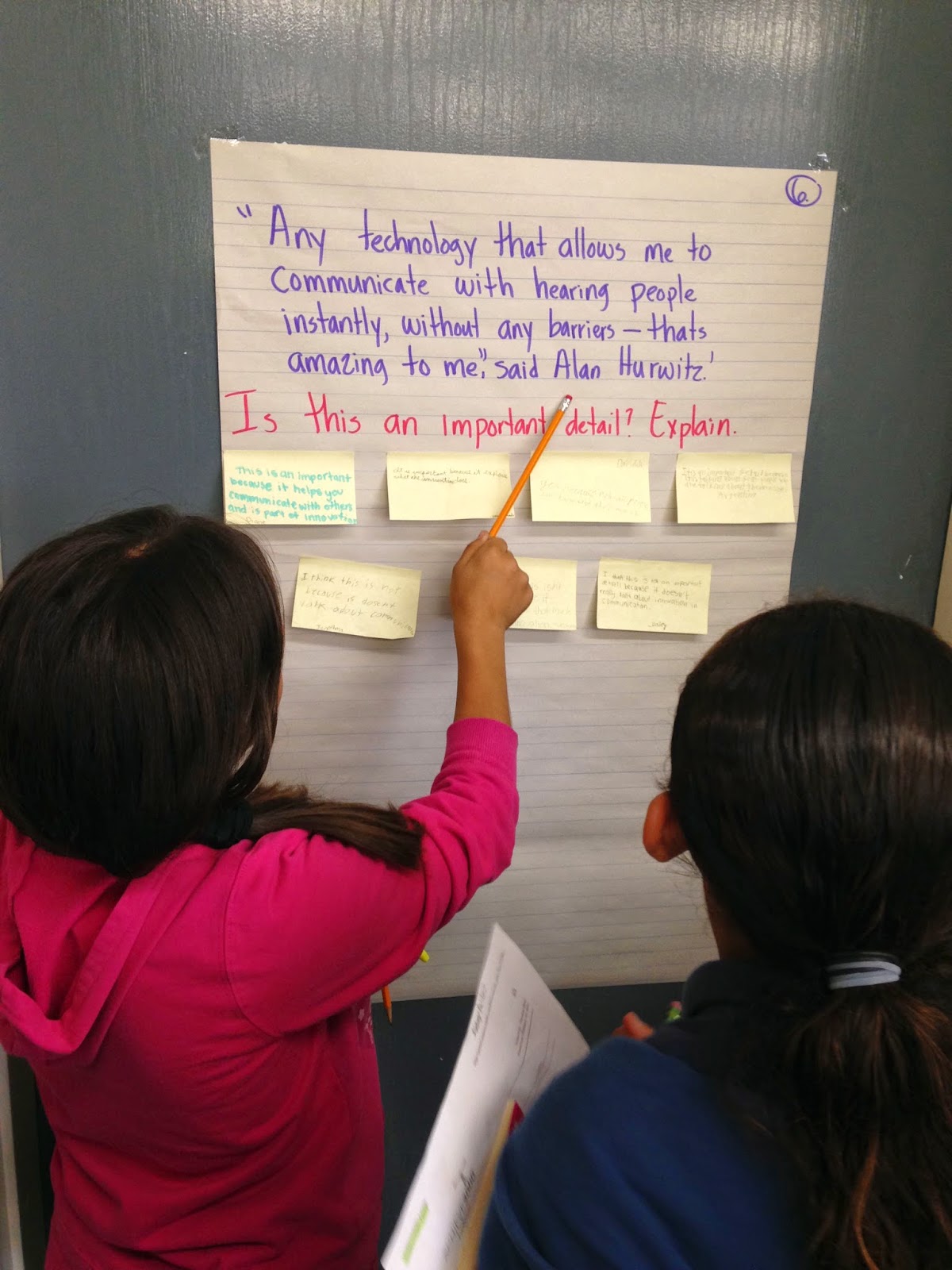
Now it was time to get them walking around and discussing! I had them strategically placed in groups...I drew a colored line on the top of their article...this made it super easy for them to get into their groups. I pulled and charted details from the article (some were important details that connected to the main idea and other details weren't as important to the main idea). They did a "gallery walk" using post it notes to explain/make a case on whether or not the detail was important and connected to the main idea of the article. As I walked around I heard a lot of great discussions! Especially if there was a disagreement...it was great to hear them making their case.


Once they made it to all the posters, we debriefed on what details were important and how the details connected to the main idea.

post signature

Thursday, February 20, 2014

Determining Point of View: Close Reading


Again using our main text, Chains by Laurie Halse Anderson, my students read closely to determine the point of view. In their ela notebooks they were to write down a quote to show the story is told from the first person point of view. Once the quote was written down, they circled 1 to 3 words in the quote that signal the first person point of view.

 I had them pair share and discuss why they thought the author chose to write the book from the first person point of view. As a class, we discussed what we gain from the first person point of view and what we lose. They struggled a bit on what we lose when a story is told in the first person point of view. It definitely had them thinking! It was great to see them refer back to the text and pull out specific examples that supported their thoughts on what we gain as readers, as well as, what we lose.

They then blogged what they wrote/discussed on their individual blogs within our class blog. The blog has been such a motivator! Especially for my students who aren't too fond of writing.


***I've been using a curriculum guide created by the amazing teachers at Curriculum Specialists blog.
post signature

Tuesday, February 18, 2014

Examining Characters: Close Reading


This lesson went so well! My students were really engaged throughout the lesson and made me proud. It was wonderful to see them discussing amongst each other and reverting back through their text (Chains, by Laurie Halse Anderson) to find the evidence!


I had them draw a quick sketch of how the envisioned the main character. Around their sketch they wrote down four-five words (character traits) that described what the character was like. Earlier in the year, we had a mini-lesson on character traits and it was awesome to see them pull out their interactive ela notebooks to reference the character trait list. Below the sketch they had to pull out a specific quote from the novel that supported each word. Most of my students were able to do this, however, I did have some students who struggled. I think they tend to get overwhelmed and didn't understand the process of scanning the book. I decided to have them stop and pair share with their partner what they wrote (I felt this would help those who may have been struggling).

The lesson continued with my students examining two of the supporting characters. You can check out the chart below for the questions.

I must say, this lesson really had my students thinking and constantly referring back to the text. As I walked around, I was able to quickly assess who needed extra support and who had it. Having them pull out quotes was a great way to have them use evidence from the text to support their statements/thoughts.


***I've been using a curriculum guide created by the amazing teachers at Curriculum Specialists blog.


post signature

Monday, February 17, 2014

Analyzing Primary Source Documents: Close Reading

This is a short and to the point post! I know I've mentioned a few times how I love reading the novel Chains, by Laurie Halse Anderson. I'm so excited that we get to use the novel as our main text and every student in my class received a copy of the book. This makes close reading so much easier! I love how the author included a primary resource at the beginning of each chapter. I've been able to incorporate those resources throughout language arts and social studies.
    

For this lesson, I had my students close read a particular primary source in the beginning of the novel. I had them pair share and discuss their thoughts and answers to the charted questions. Then they wrote their answers in their ELA notebooks. Since the beginning of the school year, I have gone over the importance of finding evidence within the text/passage to support their answers/thoughts. It was wonderful to see them doing this in their responses.


***I've been using a curriculum guide created by the amazing teachers at Curriculum Specialists blog.
post signature

Sunday, February 9, 2014

Discovering Imagery: Close Reading with Main Text: Chains

This trimester, my literacy unit is centered around the theme of "conflict." I am incorporating opinion writing (Common Core) while using the novel Chains By Laurie Halse Anderson. I created a plan that encompasses read alouds, guided reading, word work, writing, etc. Chains is a historical fiction novel that takes place during the American Revolution. Which happens to be a 5th grade social studies standard! I love being able to incorporate standards across the curriculum! It's great because my students are able to really grasp and make sense of the story because it relates to what we are learning in social studies.

Last week I taught a close read lesson on Discovering Imagery which related to our Chains novel. I charted a few passages from the text that produced a strong/bold image in our minds. I had the students read the passages and then asked them to draw a simple sketch of what image/images came to mind with those two passages. As a class we discussed what parts of those excerpts made them so powerful.

Then I gave them their task which was to find their own passage from the first five chapters that we read, which produced strong imagery in their minds. They were to copy the passage in their ELA journal, draw a simple sketch, and explain why that passage was so powerful to them. I gave them a few minutes to work on this and then had them pair share with a partner the passages they chose. Once they were done sharing with each other, I asked a few volunteers to share their passages/thoughts with the class.

The activity was a bit challenging for my group of students, but they made me proud! I loved how some of them realized that a strong image doesn't always have to come from figurative language (metaphor/simile/etc.) As I walked around the room and listened to their discussions and explanations they were right on point! 

Since we don't have time for every student to share their chosen passage and thoughts, I asked them to post the activity to their blog. I have a classroom blog through Kidblog and we use it all the time. I post discussion threads for them to think about and respond to. Each student also has a blog within our class blog to which they can make their own posts. It's been such a great way to get the students engaged! They love responding to their peers.

***I've been using a curriculum guide created by the amazing teachers at Curriculum Specialists blog.
post signature

Monday, November 11, 2013

Great Read Aloud Novels!

I've been reading like crazy the past few weeks and I must say it's been great! I was chosen to participate with a group of teachers within my school district to design the next literacy unit to correlate with the Common Core standards. The first trimester the literacy unit was based on the theme of "change" with a focus on narrative writing. The second trimester will be based on the theme "conflict" with a focus on opinion writing. I wasn't a part of the process for the first literacy unit and I've learned so much being able to participate this time around. It takes a lot time and energy, but definitely worth it!

In order to come up with a rigorous writing prompt based on the common core standards, we needed to choose a main text (a text in which we would use as a shared read, all students would have a copy) and construct the prompt around the theme and the text.

We ended up choosing Chains by Laurie Halse Anderson. It is a long read, but a great historical fiction novel about a girl, Isabel and her sister, who were promised freedom upon the death of their owner during the American Revolution (great way to tie in the social studies standards). However, that did not happen and the story follows Isabel on her journey for freedom. She battles internal conflicts (spying for the revolutionaries for freedom) and there is the external conflicts with her new owners and the war raging on.
 
 
I noticed many of my students reading The City of Ember by Jeanne DuPrau last year. They just couldn't seem to put the book down, so naturally I had to read it. I must say, I couldn't put the book down either...in fact I read it in one day. It's a science fiction novel about an underground city that is slowly running out of power and supplies. The main character Lina, manages to decode a message written by the original builders of the City of Ember. It is a nonstop suspense novel! This wasn't chosen as our main text but is on our list of read alouds. I like that it has three more books in the series, so the students can continue to read about Lina's journey.
 
 
Fever 1793 by Laurie Halse Anderson is another wonderful book. Again, it is historical fiction and takes place during the American Revolution. Unlike her last book, this book focuses on Mattie Cook and her struggle to build a better life and stay alive during the Yellow Fever epidemic. I like how the author, Laurie Halse Anderson, uses primary resources at the beginning of each chapter (she did this with her novel Chains as well). Usually excerpts from a newspaper, letter, diary that reiterates the struggles during that time in history). I also read this book in a day, I couldn't put it down!
 

One of my favorite read aloud novels is Number the Stars by Lois Lowry.  Whenever I read this book to my students they get so involved in the story line. The novel allows for in depth discussions on WWII and the injustices that went on during that time (of course in an appropriate manner for 5th grade students). This book was a read aloud for our first trimester theme of "change." While reading the book, we discussed how/what caused Annemarie and Ellen to change throughout the war. Even though WWII isn't a 5th grade standard, the book allowed for students to gain a better understanding of the world around them.

And for the last book, Maniac Magee by Jerry Spinelli. This was our shared read novel for our first literacy unit. It touches upon themes of racism and homelessness and follows the story of a boy, Jeffery Magee (Maniac) and his search for a family to love and care for him. My students really enjoyed this novel and it allowed for many great discussions.


The next novel I will tackle: Moon Over Manifest by Clare Vanderpool. Have any of you read this novel with your students? If so, what did you think?
 
I love that my new school uses the balanced literacy approach. It allows for me to introduce so many different types of novels and genres to my students. Which in turn allows for a genuine love and interest in reading. We've read 3 novels since the beginning of the school year, which I think is great!
 
 
I'd love to hear about your favorite must read novels!

 
post signature