Showing posts with label close reading. Show all posts

Friday, April 25, 2014

Finding the Main Idea and Details: Through Close Reads

My students have become pros at close reading! So proud of them!

This lesson was a big success...my kids were engaged throughout the whole process. Currently, we are focusing on informational text and our theme for this unit is innovation. We've been discussing innovations in regards to technology, transportation, communication & media, medicine, and engineering. I pulled an article from Achieve 3000 (my school site has a subscription to this program) that related to last weeks topic of communication & media. A little side note: Achieve 3000 is a great site packed with nonfiction text/articles which are differentiated to the student's reading level.

I started the lesson off with discussing the learning objective... to get the gist and determine the main idea in the Achieve 3000 article about an innovative idea that helps people communicate.

There are many different ways to annotate while close reading and depending upon what the focus of the lesson is, I have changed it up a bit. For this lesson, I used and charted the following close read strategies:

  1. Read the entire text, without stopping to get the "flow."
  2. Read a second time circling important and unfamiliar words. Write the main idea for each section or paragraph along the margin of your text.

I gave my students a few minutes to read the article independently first for the flow.

The second read was devoted to circling important or unfamiliar words and writing the main idea for each section (paragraph) in the margin of their paper. For my struggling readers, I broke the article down into specific "chunks" and gave them a large index card to cover and isolate their focus on the smaller chunks. I'm fortunate to have a teacher's aide everyday (I know practically unheard of in 5th grade!) and I had her work with a few of the focus students who needed the extra support while I facilitated the lesson.

Once they finished their second read and jotted down the main idea of each section,  I gave them a few minutes to write down what they thought the main idea for the whole text was. Next, they shared their main idea with their table partner and gave evidence in the article that helped them come up with the main idea. We came back as a whole group and a few students shared their thoughts. Together we came up and charted the main idea of the text.


Now it was time to get them walking around and discussing! I had them strategically placed in groups...I drew a colored line on the top of their article...this made it super easy for them to get into their groups. I pulled and charted details from the article (some were important details that connected to the main idea and other details weren't as important to the main idea). They did a "gallery walk" using post it notes to explain/make a case on whether or not the detail was important and connected to the main idea of the article. As I walked around I heard a lot of great discussions! Especially if there was a disagreement...it was great to hear them making their case.


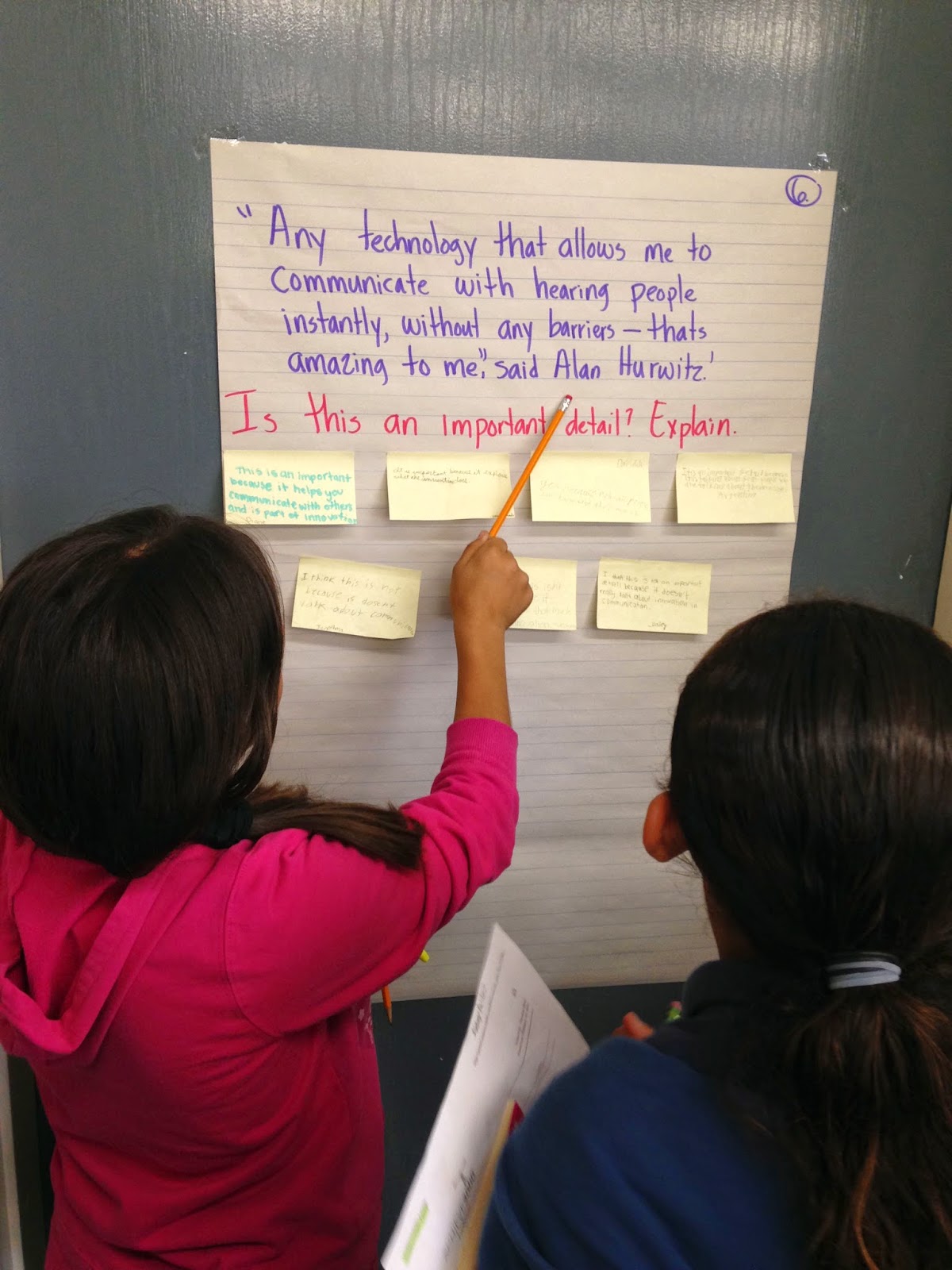

Once they made it to all the posters, we debriefed on what details were important and how the details connected to the main idea.

post signature

Thursday, February 20, 2014

Determining Point of View: Close Reading


Again using our main text, Chains by Laurie Halse Anderson, my students read closely to determine the point of view. In their ela notebooks they were to write down a quote to show the story is told from the first person point of view. Once the quote was written down, they circled 1 to 3 words in the quote that signal the first person point of view.

 I had them pair share and discuss why they thought the author chose to write the book from the first person point of view. As a class, we discussed what we gain from the first person point of view and what we lose. They struggled a bit on what we lose when a story is told in the first person point of view. It definitely had them thinking! It was great to see them refer back to the text and pull out specific examples that supported their thoughts on what we gain as readers, as well as, what we lose.

They then blogged what they wrote/discussed on their individual blogs within our class blog. The blog has been such a motivator! Especially for my students who aren't too fond of writing.


***I've been using a curriculum guide created by the amazing teachers at Curriculum Specialists blog.
post signature

Tuesday, February 18, 2014

Examining Characters: Close Reading


This lesson went so well! My students were really engaged throughout the lesson and made me proud. It was wonderful to see them discussing amongst each other and reverting back through their text (Chains, by Laurie Halse Anderson) to find the evidence!


I had them draw a quick sketch of how the envisioned the main character. Around their sketch they wrote down four-five words (character traits) that described what the character was like. Earlier in the year, we had a mini-lesson on character traits and it was awesome to see them pull out their interactive ela notebooks to reference the character trait list. Below the sketch they had to pull out a specific quote from the novel that supported each word. Most of my students were able to do this, however, I did have some students who struggled. I think they tend to get overwhelmed and didn't understand the process of scanning the book. I decided to have them stop and pair share with their partner what they wrote (I felt this would help those who may have been struggling).

The lesson continued with my students examining two of the supporting characters. You can check out the chart below for the questions.

I must say, this lesson really had my students thinking and constantly referring back to the text. As I walked around, I was able to quickly assess who needed extra support and who had it. Having them pull out quotes was a great way to have them use evidence from the text to support their statements/thoughts.


***I've been using a curriculum guide created by the amazing teachers at Curriculum Specialists blog.


post signature

Monday, February 17, 2014

Analyzing Primary Source Documents: Close Reading

This is a short and to the point post! I know I've mentioned a few times how I love reading the novel Chains, by Laurie Halse Anderson. I'm so excited that we get to use the novel as our main text and every student in my class received a copy of the book. This makes close reading so much easier! I love how the author included a primary resource at the beginning of each chapter. I've been able to incorporate those resources throughout language arts and social studies.
    

For this lesson, I had my students close read a particular primary source in the beginning of the novel. I had them pair share and discuss their thoughts and answers to the charted questions. Then they wrote their answers in their ELA notebooks. Since the beginning of the school year, I have gone over the importance of finding evidence within the text/passage to support their answers/thoughts. It was wonderful to see them doing this in their responses.


***I've been using a curriculum guide created by the amazing teachers at Curriculum Specialists blog.
post signature

Sunday, February 9, 2014

Discovering Imagery: Close Reading with Main Text: Chains

This trimester, my literacy unit is centered around the theme of "conflict." I am incorporating opinion writing (Common Core) while using the novel Chains By Laurie Halse Anderson. I created a plan that encompasses read alouds, guided reading, word work, writing, etc. Chains is a historical fiction novel that takes place during the American Revolution. Which happens to be a 5th grade social studies standard! I love being able to incorporate standards across the curriculum! It's great because my students are able to really grasp and make sense of the story because it relates to what we are learning in social studies.

Last week I taught a close read lesson on Discovering Imagery which related to our Chains novel. I charted a few passages from the text that produced a strong/bold image in our minds. I had the students read the passages and then asked them to draw a simple sketch of what image/images came to mind with those two passages. As a class we discussed what parts of those excerpts made them so powerful.

Then I gave them their task which was to find their own passage from the first five chapters that we read, which produced strong imagery in their minds. They were to copy the passage in their ELA journal, draw a simple sketch, and explain why that passage was so powerful to them. I gave them a few minutes to work on this and then had them pair share with a partner the passages they chose. Once they were done sharing with each other, I asked a few volunteers to share their passages/thoughts with the class.

The activity was a bit challenging for my group of students, but they made me proud! I loved how some of them realized that a strong image doesn't always have to come from figurative language (metaphor/simile/etc.) As I walked around the room and listened to their discussions and explanations they were right on point! 

Since we don't have time for every student to share their chosen passage and thoughts, I asked them to post the activity to their blog. I have a classroom blog through Kidblog and we use it all the time. I post discussion threads for them to think about and respond to. Each student also has a blog within our class blog to which they can make their own posts. It's been such a great way to get the students engaged! They love responding to their peers.

***I've been using a curriculum guide created by the amazing teachers at Curriculum Specialists blog.
post signature